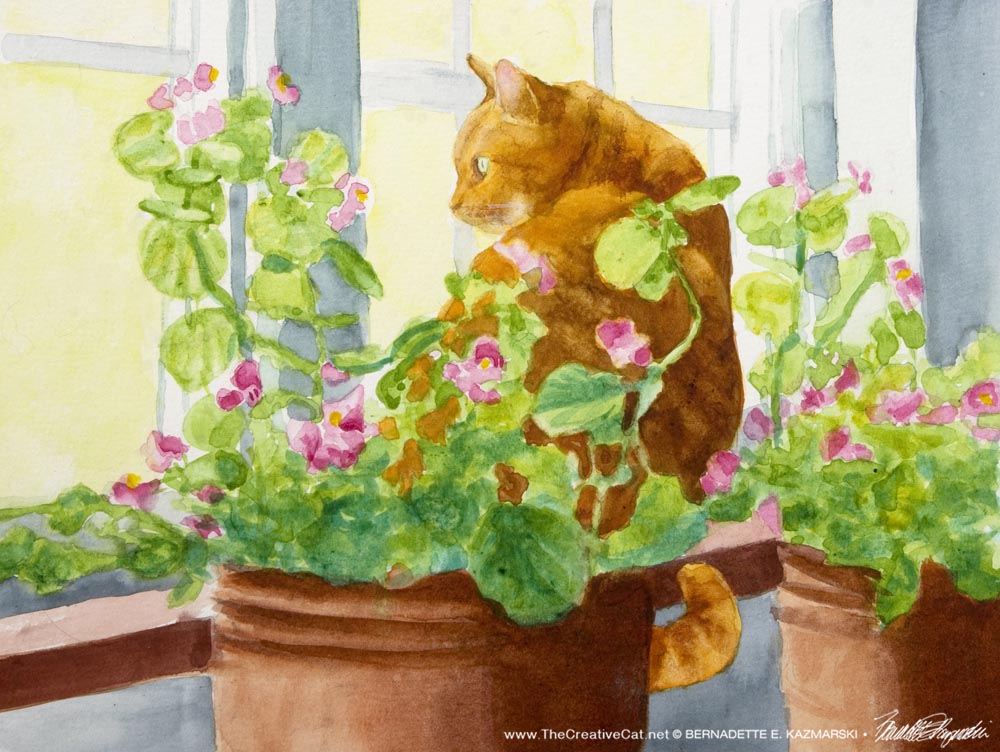
“Peach Begonias,” watercolor, 9″ x 12″, 2023 © Bernadette E. Kazmarski
Great Rescues Day Book also has an overview of important information about your cat’s health and welfare, from basic needs to veterinary visits, spay and neuter and trap-neuter-return, and more. I drew from my decades of living with, rescuing and fostering cats what seemed the most common information you’d need. I included it in the back of the book so you’d have it on hand in an easily accessed place when you need it. Here is the content for the section with an overview on toxins and plants.
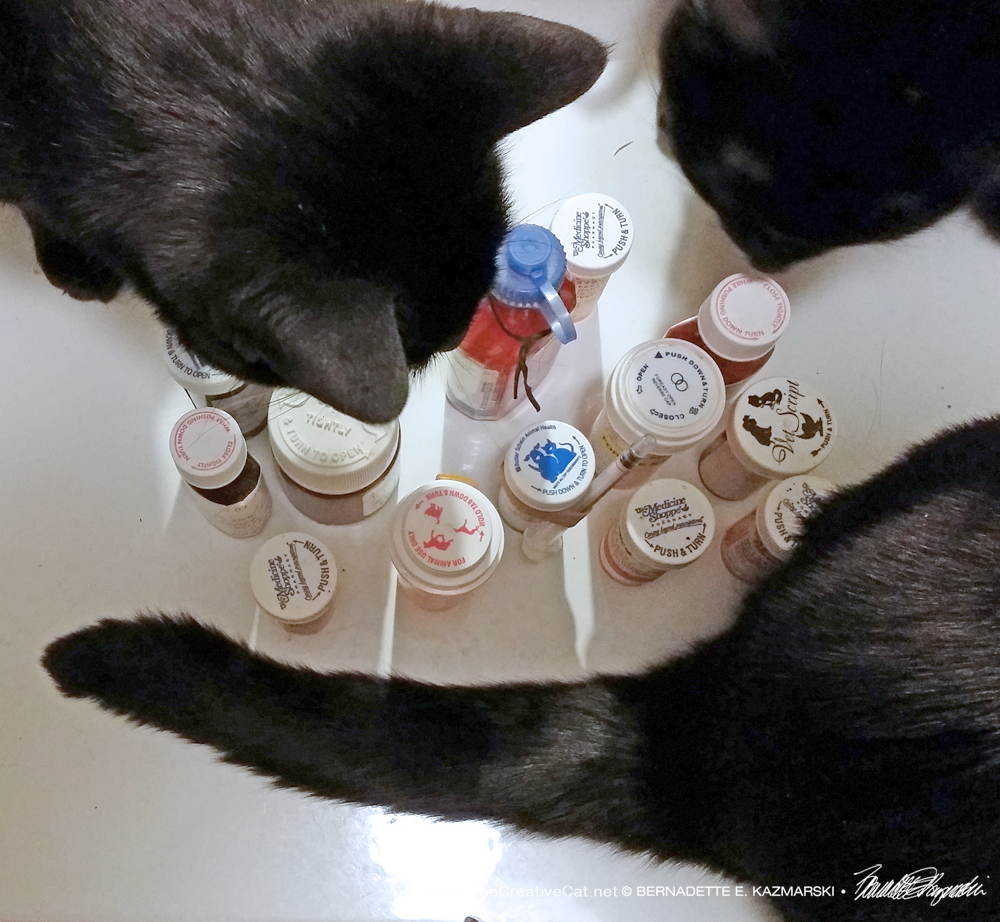
Human medications are always in the top 10 toxins for cats.
Toxic substances around the house
“Toxic” doesn’t simply mean a substance is lethal, it can also refer to substances that can sicken or cause permanent physical or neurological damage. Cats are so sensitive to their environment that it’s safest to presume that anything other than their food has a potential to be toxic, and it’s not just from what they might actually accidentally eat.
Cats bathe themselves and so anything that might land on their fur or skin will end up in their bodies, and they are also small enough that substances that could be absorbed through the skin can provide a dangerous or lethal dose of toxin. Young kittens, older cats or those who are ill or with a compromised immune system will have a greater reaction to environmental toxins than healthy adults.
Always be careful with cleaning products and other household chemicals such as paint and varnishes, plant and lawn fertilizers and pesticides and even art materials and keep them safely locked away. Don’t assume because they smell funny or seem to be unappetizing that your curious cat won’t try to taste them or that there is no residue on the container or in the storage area where you keep them. And because of antifreeze and the residues of fluids and lubricants that drip out of your car, the garage should be totally off limits.
Cleaning products
Keep them locked safely away and take care with their use. Cleaning products generally contain bleach or ammonia, both of which are toxic to cats if they ingest it somehow, including absorbing it through their paws by walking on a surface which has been cleaned with it, even after it’s dried. They may also suffer irritation, lesions or burns if they come in contact with it at full strength, and even the fumes in an enclosed space can cause respiratory distress or actual damage to the respiratory system as well as neurological damage. They also contain other chemicals and perfumes which can be toxic to varying degrees.
And unlike humans who are simply taller, your cat is right down there with the products when they’ve been applied, on the floor, on the furniture, even in their food and water bowls. In an area where your cat eats, walks, sleeps, plays or in any way interacts with its environment, it’s best to stick with a non-toxic cleaner and make sure all surfaces are dry before your cat walks on them.
Essential oils, potpourri and such
Oily substances are readily absorbed by the skin and most cats will quickly attempt to clean anything from their fur. Even naturally-derived oils you may use around the house as air fresheners or aromatherapy, those in scented soaps and lotions, shampoo and styling products, cosmetics and other health and beauty products can cause a range of reactions from physical irritation and vomiting to respiratory, cardiac and neurological damage to your cat if she comes in contact with it in a way she can ingest it or absorb it into her skin.
The oil in dried potpourri can be toxic because the oil remains active and does not evaporate. The ingredients of the potpourri can also be toxic and dangerous because it is often aromatic bark chips, dried plant leaves, flower parts and petals and can cause a toxic reaction from both the oils and perfumes and from the sharp edges of the materials.
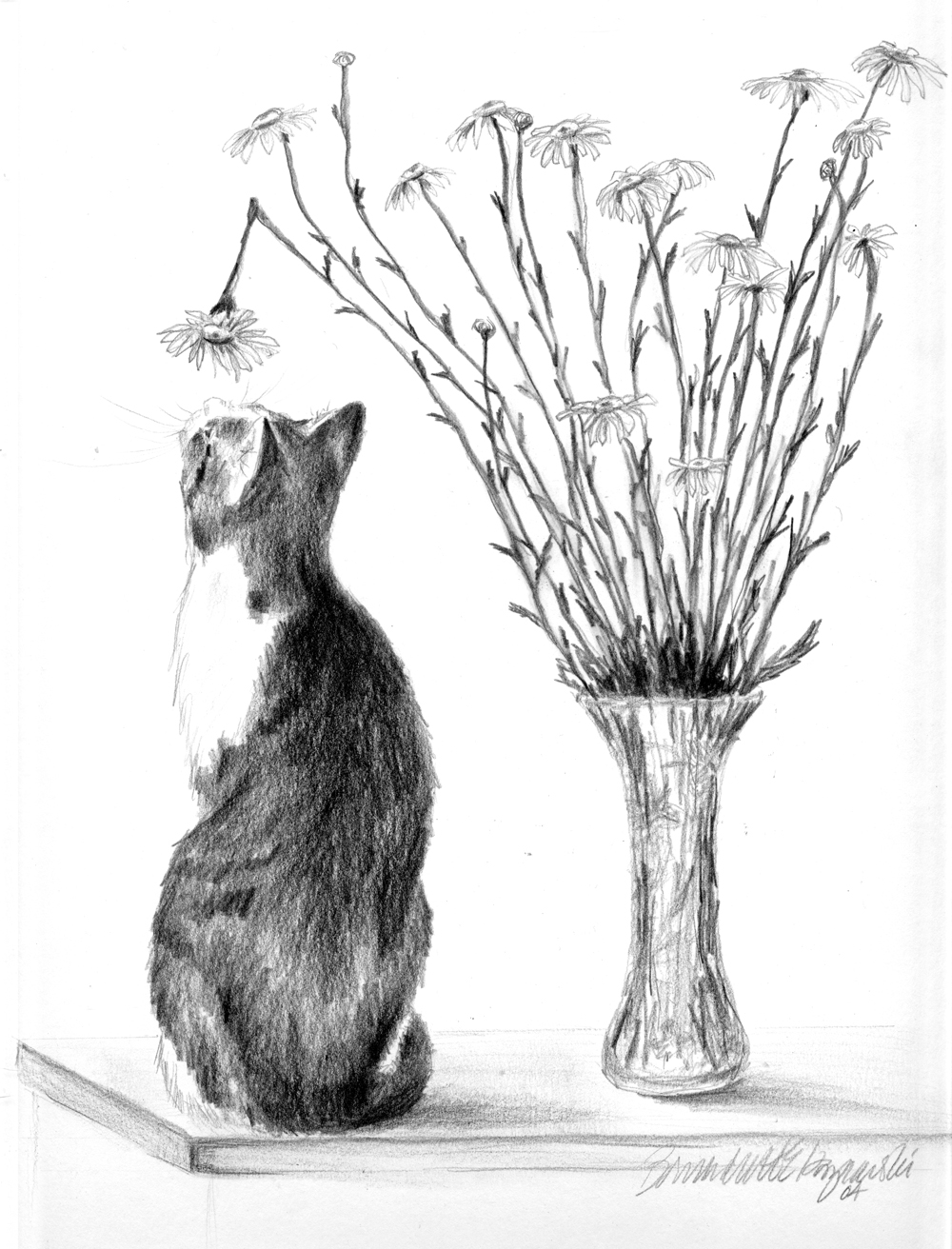
“Conversation With a Daisy,” pencil, 8″ x 10″, 2004 © Bernadette E. Kazmarski
To my knowledge daisies are not toxic but I wanted to share the illustration!
Poisonous plants
You can’t really punish them for following what seems to be a natural impulse and a physical need. We don’t really know why cats, obligate carnivores, chew on grasses and green things, but it may be to help cleanse their mouth and digestive system, and to add fiber to their primarily protein diet to aid in elimination.
An indoor kitty will take what she can get to simulate the natural outdoor environment she craves, digging in the soil of a potted plant or making a bed of a lush, healthy pot of foliage. Cats aren’t necessarily particular in what they’ll nibble on; generally they’ll try anything green, and some cats will completely chew down a plant that can’t have tasted very good and wasn’t very easy to chew.
While it may be amusing if you’re not too attached to your plants, it can be EXTREMELY DANGEROUS to your cat. Several common houseplants, or plants we bring in for some holidays or for winter, are deadly, and another longer list can cause a range of symptoms from temporary discomfort to permanent health problems.
For instance, all species of lilies, and all parts of the lily, can cause kidney failure in cats. Within only a few hours of chewing and/or swallowing a portion of the plant, the cat may become lethargic or develop a lack of appetite, symptoms which are difficult to determine right away, and she may vomit, all the while the irreversible kidney damage progresses. Without prompt and proper treatment by a veterinarian, the cat will slip into kidney failure in as little as 36 hours.
While most plants are not that immediately toxic, other plants, such as azalea, lily of the valley, yew and bulbs we might force to bloom, including tulip, daffodil and crocus, can be deadly to cats in impaired health or kittens, since they’re small enough to get a big dose with an enthusiastic bite. Though not deadly for adult cats in good health, they’ll often cause extreme abdominal pain, nausea, salivation and vomiting. Repeated exposure can be cumulative with some plants.
That was not intended to frighten, but to illustrate the seriousness of the cat and plant issue. The problem is that, while you may get some cats to stay away from your plants, most cats will return again and again, even if they suffer discomfort from their snack. The best way to keep your cats safe from plants is to put the plants completely out of reach—bearing in mind that cats can jump five to seven times the height of their tail and can be ingenious about launching from strategic furniture to get into a hanging basket. Sometimes it is necessary to completely remove the plant from the house, no matter how much you like it.
Don’t forget that these plants are often included in cut flower arrangements, so inspect any bouquets that come into the house.
Signs of plant poisoning may include vomiting, diarrhea, and swelling or pain inside the cat’s mouth. If you know or suspect which plant your cat has eaten, identify the plant by name when you call your veterinarian. Bring samples of the plant’s leaves or flowers when you take your cat to the veterinarian for treatment.
Keep toxic plant and flower information handy. Your local veterinarians and shelters often have lists of toxic flora as handouts, and plenty of resources exist on the internet. Here is a list of 17 common poisonous plants provided by the ASPCA, but also visit the link below to read exactly how each plant is toxic and find out more about toxic plants.
Lilies
Sago Palm
Tulip/Narcissus bulbs
Azalea/Rhododendron
Oleander
Castor Bean
Cyclamen
Kalanchoe
Yew
Amaryllis
Autumn Crocus
Chrysanthemum
English Ivy
Peace Lily (AKA Mauna Loa Peace Lily)
Pothos Philodendron
Schefflera
FOR MORE INFORMATION ON PLANTS:
ASPCA Searchable Database of Plants, with photos and descriptions, updated regularly:
www.aspca.org/pet-care/poison-control/plants
NOTE: the link in the book has changed but it will forward you to the correct page.
FOR ANY TOXINS AND FOR ANY ANIMAL:
ASPCA Online Poison Control Center including plants, medications, cleaning products and most other toxins your pet could come in contact with:
www.aspca.org/pet-care/poison-control/
Both of the hotlines below are available 24/7/365 providing live consultation for animal poison emergencies. The credit card charge covers the initial phone consultation and any follow-up consultation you or your veterinarian may need for your case. For instance, if you call and find out that the toxin your cat has come in contact with needs to be treated by a veterinarian, you can give your case number to your veterinarian and they can also call the hotline for recommendations on treatment. There is no further charge.
ASPCA ANIMAL POISON CONTROL CENTER 888-426-4435, www.aspca.org/pet-care/poison-control/
Credit card charge covers the initial phone consultation and any follow-up consultation.
pet poison helpline 800-213-6680, www.petpoisonhelpline.com
Affiliated with the University of Minnesota Veterinary Medical Center, C$35 credit card charge.
©2011-2025 Bernadette E. Kazmarski | All Rights Reserved.
No content may be used without WRITTEN PERMISSION from the author.
Great Rescues Calendar and Great Rescues Day Book are published by Beauty of a Moment Publishing
Site designed by Bernadette E. Kazmarski
Discover more from Great Rescues Day Book
Subscribe to get the latest posts sent to your email.
Leave a Reply